

What is Search Engine Optimization (SEO) ?
SEO stands for Search Engine Optimization.
Search Engine Optimization consists of two words :-
- Search Engine – To put it simply, It is a software that searches information from internet . In other words, Search Engine is a system created to find the data present on the internet. Internet has lakhs of websites and data. To search that data, Search engine is made.
In other words, SEARCH ENGINE is a software designed to carry out web searches
- Optimization – It also known as the process of using something perfectly, involves the action of making the best or most effective use of a situation or resources.
Thus, The Best Optimization of Search Engine in Search Engine Optimization i.e. the use of search engine to your advantage in a better way.
“SEO is the process of making websites , web pages better for search engines so that it can rank higher.”
Therefore, Search Engine Optimization (SEO) is a set of practices and techniques aimed at optimizing a website or online content to improve its visibility and ranking in search engine results pages (SERPs). The ultimate goal of Search Engine Optimisation (SEO) is to drive organic (non-paid) traffic to a website by making it more appealing to search engines.
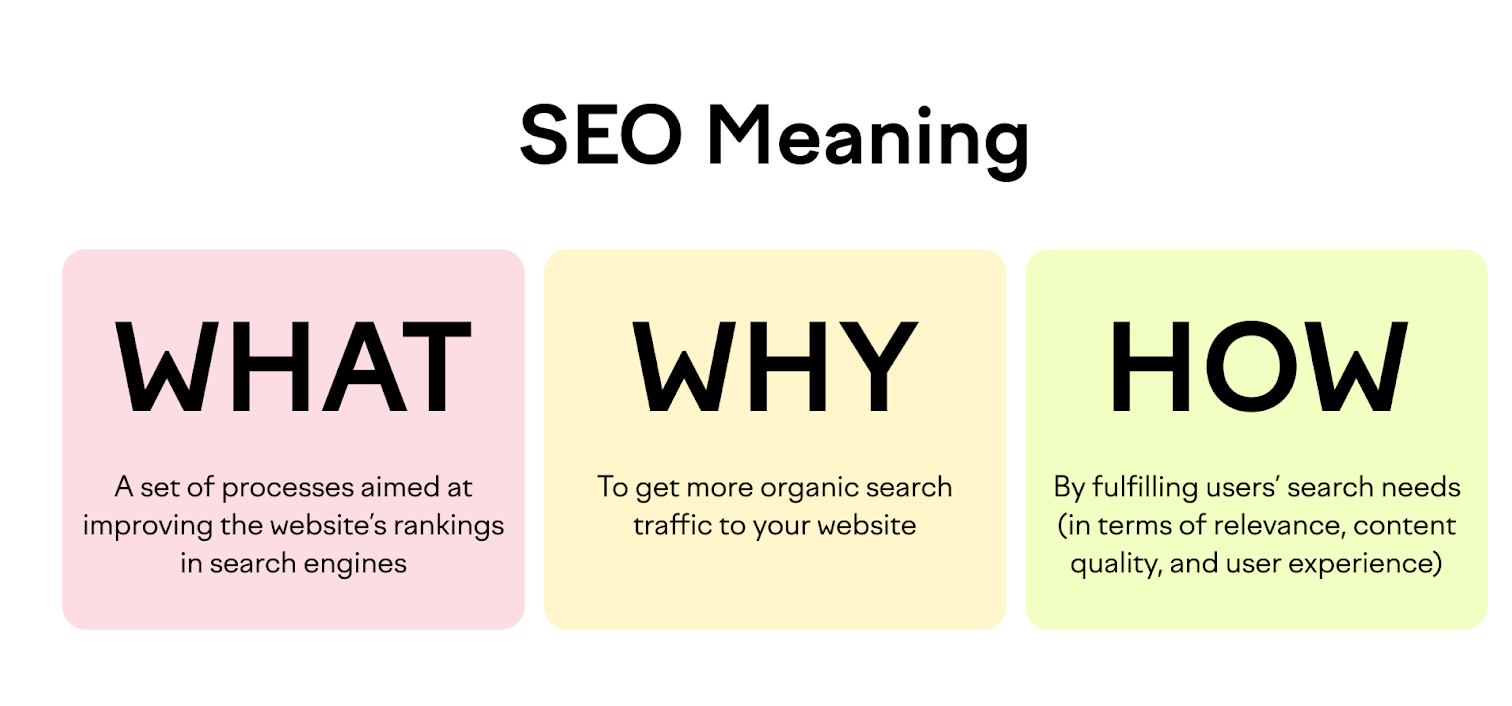
Source : Semrush
The key components and aspects of SEO:
1. Keyword Research: This involves understanding the specific words and phrases that individuals use when searching for information related to your business. The website content strategically incorporates these keywords.
2. On-Page SEO: On-Page SEO focuses on optimizing various elements directly on the website to improve its visibility to search engines. This includes optimizing meta tags, headings, content, images, and URL structures.
3. Off-Page SEO: Off-Page SEO involves enhancing the authority and credibility of your website by acquiring backlinks from reputable and relevant websites. This achieves with the use of guest blogging, influencer outreach, and social media engagement strategies.
4. Technical SEO: Technical SEO concentrates on the technical aspects of a website to ensure that it is easily accessible and indexable by search engines. This includes optimizing site speed, ensuring mobile-friendliness, optimizing URL structure, and ensuring secure connections (HTTPS).
5. Local SEO: Local SEO is particularly relevant for businesses with physical locations, as it focuses on optimizing a website to rank better in local search results. This involves activities such as local business listings, customer reviews, and location-specific keyword optimization.
6. Content Marketing: Creating high-quality, relevant, and valuable content that meets the needs of the target audience. Content helps attract and engage visitors, leading to higher rankings and increased organic traffic.
7. User Experience : Providing a seamless and enjoyable experience for visitors, including easy navigation, fast page load times, and a responsive design. Positive user experience contributes to higher rankings.
8. Analytics and Performance Monitoring: Using tools like Google Analytics to track website performance, user behavior, and other metrics. Analyzing this data helps in refining SEO strategies for better results.
9. SEO Best Practices and Guidelines: Staying informed about the latest SEO trends, algorithm updates, and best practices recommended by search engines like Google, Bing, and others.
Search Engine optimisation (SEO) is an ongoing process, and the rules and algorithms used by search engines are constantly evolving. It requires consistent effort, monitoring, and adaptation to changes to maintain or improve a website’s search rankings and visibility.
=> What is History of SEO ?

Source : Inzone design
SEO came in 1991. However, the first website was created around this time. Additionally, many websites were made in two years, which caused a problem for searching content. Because of which Search Engine Optimization was introduced.
Larry Page and Brin started building the most successful search engine till today “BACKRUB” in the year 1996, and they later named it Google.
SEO EVOLUTION => Google saw the opportunity and started working on Algorithms that were giving values to quality, relevant content , etc.
=> Types of SEO ?
Search Engine Optimisation (SEO) is the practise of increasing the number and quality of visitors to a website by improving rankings in the algorithmic search engine results
Types of Search Engine Optimisation (SEO) :-
- On Page SEO
- Off page SEO
- Technical SEO

Source : mnlabs
On Page SEO relates to the content on your website. If you make any changes in the content of your website so that we rank in the results of the search engine. On Page SEO is optimisation of the content that is present on the website. Example – Meta Tag, Internal Links, etc. These are necessary for search engine to understand our website
Off Page SEO is about establishing the relationship through backlinks. Additionally, Off Page SEO is focused on creating visibility, authority, and trust for the website. Most importantly, Offpage SEO primarily involves link building. In other words, we link other websites to add back to our websites. Kola Marketing serves as an example of Off Page SEO.
Technical SEO verifies whether a website caches and compresses correctly. It directly affects the page speed of the website. Procuring an SSC Certificate is also part of Technical SEO.
=> Consider the following points to rank the website on top of the page :-
- Content
- Website Speed
- Keywords
- Meta Description
- Title
- Images in the website
To rank the website all above points are to be taken care.
=> Demand of Search Engine Optimisation (SEO) in the Market ?
Lakhs of people make websites every day in the Digital Era, however, this is causing an increase in the demand for SEO. As a result, there are various career options for SEO experts :-
- Job (Salaried Employee ) – 15,000 – 50,000 (and more , Depending on experience, city and state)
- Freelancer – 1,00,000 – 3,00,000 ( and more as per the projects you get per month and speed and quality of your work)
- Youtube Channel – (Revenue Depends On the Audience)
- Coaching – (Revenue depends on number of students and the fees)
=> How Search Engines work ?
First, search engines like Google, Bing, Yahoo, and others have a mission: to organize the internet’s massive amount of information and make it accessible and useful for everyone. They accomplish this through a process that involves three main steps: crawling, indexing, and ranking.
1. Crawling / Spider –
Imagine a team of diligent explorers (often referred to as bots or spiders) travelling the city, visiting each building (website), and meticulously documenting what’s inside. These bots constantly roam the internet, following links from one webpage to another.
When they discover a new website or a new page on a website, they “crawl” it, meaning they read the content and all the code that makes it up. They take note of all elements such as words, images, links, and other elements on the page.
2. Indexing –
Once the bots have gathered this information, they organize it into a massive database, much like a librarian cataloging books in a library. Additionally, this database is called an index. It’s like the city directory that helps you quickly find a building’s location and details.
The index is structured in a way that enables the search engine to retrieve relevant information lightning-fast when someone performs a search.
3. Ranking –
Now, you’re someone looking for a specific type of building, say, a cozy café in the city. When you ask for suggestions, the search engine’s ranking algorithm comes into play. First, the algorithm scans through its database of information. Then, it analyzes the relevance and popularity of each café.
Next, it assigns a ranking based on these factors. After that, the search engine displays the results in order of their ranking. Finally, you can browse through the list of suggested cafés and choose the one that suits your preferences.
Based on these factors, it creates a list of recommendations, ranking them from the best to the not-so-great.
The magic isn’t just in how search engines crawl, index, and rank pages; it’s also in their ability to understand your question. When you type a query into the search bar, the search engine deciphers your words, analyzes the intent behind them, and then matches that intent to the most suitable buildings (websites) in the city (internet).
Moreover, these search engines are constantly learning, improving, and updating their algorithms to enhance the accuracy of their recommendations.

Source : Linkedin
How Can You Stand Out in this Digital City?
If you own a building (website) in this vast city (internet), you want it to be visited and loved. This is where the art and science of SEO come in. SEO is like putting up bright signs, decorating your café, and creating a welcoming atmosphere to attract more visitors. Additionally, SEO helps improve the visibility and ranking of your website, increasing its chances of being discovered by potential visitors. By implementing effective SEO strategies, you can ensure that your website stands out among the competition and draws in more traffic.
By understanding what the ‘tourists’ (search engine users) are looking for and optimizing your ‘café’ (website) to meet those needs, you increase your chances of being recommended by the helpful ‘guides’ (search engines).
In a nutshell, search engines are the magical guides of the internet city, and SEO is the secret sauce that helps you become the favorite destination for everyone seeking what you have to offer in this bustling digital metropolis.
The most important SEO tasks have to do with:
- Identifying what users are searching for that is related to your products and services
- Creating content that will make users happy
- Providing the right signals to search engine crawlers and algorithms through various SEO techniques
SEO is important because:
- The majority of search engine users (more than 70% – see graph below) are more likely to click on one of the top 5 suggestions in the search engine results pages (SERPS). To take advantage of this and gain visitors to your website or customers to your online store, your website needs to appear in one of the top positions.
- SEO is not only about search engines but good SEO practices improve the user experience and usability of a website.
- Users trust search engines and having a presence in the top positions for the keywords the user is searching, increases the website’s trust.
- SEO is good for the social promotion of your website. People who find your website by searching Google or Bing are more likely to promote it onplatforms such as Facebook, Twitter, or other social media channels.
- SEO is important for the smooth running of a big website. Websites with more than one author can benefit from SEO in a direct and indirect ways. Their direct benefit is an increase in organic traffic and their indirect benefit is having a common framework (checklists) to use before publishing content on the site.
- SEO can put you ahead of the competition. If two websites are selling the same thing, the search engine optimized website is more likely to have more customers and make more sales.
Key Learnings
What is SEO?
SEO is a set of rules for optimizing your website so that it can achieve higher rankings in search engines’ organic results.
In Simple Language , Any place on the internet where humans search content is called search engine (Google, Yahoo, Bing, Youtube ,etc) and to explain to search engines that our content is best to show the audience that is called Search Engine Optimisation.
This is called Search Engine Optimisation (SEO) , which means optimizing our websites in such a better way that they appear on the top ranks of search engines which will boost my business, increase the conversion rate & ultimately make the business grow.
Why is SEO important?
The majority of search engine traffic goes to the top 5 results. Additionally, with SEO, your website can appear in one of the top positions for your target keywords and get visits to your website.
Can you do SEO yourself?
Yes, there are various SEO courses and online guides that can help you learn and do SEO on your own. Besides learning the theory, the best way to learn SEO is through practice.
Pingback: On Page SEO and Off Page SEO : Your Complete Guide