

SEO stands for Search Engine Optimization. It consits of On Page SEO and Off Page SEO.
Search Engine Optimization is made from two words :-
- Search Engine – It is a software that searches information from the world wide web . For Example Google, Yahoo,etc.
- Optimization – The action of making the best or most effective use of a situation or resources.
Therefore, SEO is the process of making websites , web pages better for search engines so that it can rank higher.
So the goal of SEO is to increase the amount of organic traffic to a website by making it more appealing to search engines.
SEO helps in ranking our website to the first page of Search Engine (Google).
Types of SEO :-
1) On Page SEO
2) Off Page SEO

Search Engine Optimization (SEO) includes On Page SEO and Off Page SEO. Both have different roles to play in SEO and both are equally important.
On-Page SEO is all about optimizing the parts of your site that you can control.
Off-page SEO, on the other hand is about building up your domain’s authority by creating content and building up your backlinks.
To get a better idea of what’s going on, let’s take a closer look at how search engines work.
On Page SEO
It is optimizing all the parts of the website that you can control and optimize.
On page SEO consists of following checklist :-
(1) Keyword (2) Slug
(3) Meta Description (4) URL Structure
(5) Site content (6) Subheadings
(7) Images (8) Internal Links
(9) Outbound Links (10) Title Tags
(11) Headings (12) Alt Text Images
(13) Mobile Friendliness (14) User Experience

Factors Affecting On Page SEO
Keyword :- A keyword refers to a specific phrase that users enter into search engines when looking for information, products, or services.
Understand the target audience and on the basis of that we have to do the keyword research.
Keywords are integral to SEO because search engines use them to identify and rank web pages in their search results. So come on top of search engine we have to use the right keywords on a webpage.
Thus, Website owners optimize their content and other on-page elements with relevant keywords to improve their website’s visibility in search engine.
To search keywords we can also use tools like :-
Google Keyword Planner, Ahrefs, Ubersuggest, Semrush, Moz, and many more.

Keywords can be of two types :-
Short Tail Keywords – These are brief and typically one to three words long. They often have high search volume and competition. For example, “wedding” or “digital marketing”. For ranking the website use short tail keywords. But it will take some time to rank.
Long Tail Keywords – These are more longer phrases which are three or more words. These have lower search volume and lower competition. For example, “wedding venues in mumbai” or “digital marketing strategies for small businesses”. For selling products use long tail keyword.
2) Slug – In SEO, a “slug” refers to the portion of a URL that identifies a specific page. It is typically a user-friendly and descriptive text string that appears after the domain name in a URL. Slugs are important for both search engines and humans as they provide a clear indication of the page’s content. So, using relevant keywords in slugs can help improve the SEO of a webpage by making it more accessible and understandable to visitors.

3) Meta Description – It is of generally 2-3 lines approx 150-180 words that summarizes the content of web page. It is not visible on the page itself but is displayed in search engine results pages (SERPs) below the page title. Therefore, it’s purpose is to provide a concise and relevant preview of what a user can expect to find on the web page. It also helps them decide whether to click on the link or not. An effective meta description should be compelling, include relevant keywords, and entice users to visit the webpage. It also plays a crucial role in attracting organic search traffic and improving click-through rates from search engine results.

4) URL Structure – In SEO (Search Engine Optimization), URL structure refers to the format and organization of web page addresses that make up a website’s URLs. A well-structured URL should be clear, descriptive, and user-friendly, making it easy for both search engines and human visitors to understand the content and context of the page. A good URL structure can improve a website’s SEO by enhancing the user experience and helping search engines better index and rank the pages.
5) Site content – The content you include on your pages must be relevant to the searcher. For example, If the searcher is looking for something specific, they won’t be able to easily find your page. So, it must be easy to understand and provide value for the searcher. Google has different criteria for determining whether your content is relevant. Keep your each blog to 500 words or more. Although there’s no definitive number, Google prefers a page with a lot of high-quality content around your targeted keywords. Your copy must be specific to each page on your website, not copied from other pages, and should be focused directly on your visitor’s search questions. Keywords should be placed closer to the top of the page, but only if they sound natural.
6) Subheadings – Subheadings, also known as subheadings or sub-headings, are secondary or subordinate headers that appear below a primary or main heading. They are used to further separate and organize content within a large section or chapter of your document, article or webpage. Subheadings are often used to introduce and summarise the content that follows. They also provide structure and organization to your text.
7) Images – Images in SEO play a significant role in enhancing the overall user experience, improving website engagement, and contributing to better search engine rankings. Images help in SEO by increasing Visual Appeal, Reducing Bounce Rate, Content Complement,Mobile Optimization, etc.
In summary, images in SEO serve to make your website more engaging, informative, and accessible to users. Proper image optimization, including descriptive filenames, alt text, and proper formatting, can help improve search engine rankings and drive more organic traffic to your site.
8) Internal Links – Internal links in SEO refer to hyperlinks that connect different pages within the same website. These links are essential for Navigation and User Experience, Content Organization,Distributing Page Authority, SEO and Indexing, Keyword Optimization, Reducing Bounce Rate, Enhancing Page Relevance, etc.
If you want to get the most out of your internal linking in SEO, it’s important to use the right anchor text, link to relevant content, avoid too many or irrelevant links, make sure your structure is logical and easy to use, and keep an eye on your internal links to make sure they’re up-to-date. All of these things can help you improve your SEO and give your users a great experience.
9) Outbound Links – Outbound links, also known as external links, refer to hyperlinks that direct users from your website to another website or domain. In the context of SEO (Search Engine Optimization), outbound links play a significant role and are important for credibility and trust, user experience, content validation , topic relevance , relationship building,etc. Using outbound links for SEO can make your content more trustworthy and relevant, make it easier for people to use, and show that you’re serious about helping people find the info they need. But it’s important to use them wisely and make sure they match up with the rest of your website’s goals and features.
10) Title Tags – Title tags, in the context of SEO (Search Engine Optimization), are HTML elements that define the title of a web page. These title tags are displayed in the browser’s title bar or tab and are also shown as the main link in search engine results pages (SERPs). Title tags are a critical on-page SEO element that helps users and search engines understand the content and purpose of a web page. Crafting well-optimized, compelling title tags is essential for improving search rankings, increasing user click-through rates, and enhancing the visibility of your website in search engine results.
11) Heading – Headings in SEO refers to the HTML heading tags like <h1>, <h2>, <h3> etc. that are used to organize and format the content of a web page. Headings play an important role in on-page SEO as well as in user experience. What are the main headings in SEO?
- Headings help organize your content into logical sections. The main heading, often <h1> on a page, represents the main topic or title.
- Subheadings, such as <h2> and <h3> are often used to represent related keywords. This structure helps users and search engines understand the structure of your content.
- Readability – Headings make it easier for users to find the information they’re looking for.
- Keyword optimization- Headings allow you to include relevant keywords in your content, which signals to search engines what it’s about.
- Heading tags can have a positive impact on search engine rankings by improving the visibility of your content. For example, a well-structured piece of content that has clear headings is more likely to show up in featured snippets.
In conclusion, heading in SEO helps to organize your content and optimize it for search engines as well as users. When used correctly, heading tags help in keyword optimization. It also helps in content structure, and readability, resulting in better user experience and higher search engine rankings.
12) Alt Text Images – ALT text, short for “alternative text,” in SEO (Search Engine Optimization), is a descriptive text attribute added to HTML image tags. Here’s a brief overview of ALT text in SEO:
- Accessibility: The primary purpose of ALT text is to provide a textual description of an image for users who cannot see it. Screen readers and other assistive technologies use ALT text to convey the content and meaning of images to individuals with visual impairments, making web content more accessible.
- SEO Optimization: ALT text plays a critical role in SEO by providing search engines with context about the content of an image. Search engines cannot “see” images but rely on ALT text to understand what the image represents. Including relevant keywords in ALT text can improve the image’s chances of appearing in search engine results, especially in Google Images and other image search engines.
- Image Loading Failures: In cases where an image fails to load on a webpage (due to slow internet connection or other reasons), the ALT text is displayed in place of the image. This ensures that users still receive meaningful information even when the image is not visible.
In summary, ALT text is a vital element in SEO and web accessibility. It serves to describe images to those who cannot see them and provides valuable information to search engines, contributing to better rankings and overall user experience on the web.
13) Mobile Friendliness – Mobile friendliness here refers to the practice of optimizing a website to be user-friendly on mobile devices.
It’s crucial for better search engine rankings, user satisfaction, and the success of your online presence. As we all know that mobile users are increasing day by day.
14) User Experience – In SEO it refers to optimizing web pages to provide the best possible experience for visitors. A positive user experience not only satisfies users but also aligns with search engine ranking factors. User experience in on-page SEO includes
a)Page Load Speed, b) Mobile Friendliness,
c) Content Relevance, d) Readability and Clarity,
e) Navigation , f) Site Structure,
g) Engagement
h) Avoiding Intrusive Elements like Pop Ups
i) Accessibility of visitors,
j) Security, and
k) Indexing.
In summary, a positive user experience is integral to on-page SEO. It not only enhances user satisfaction. It also aligns with Google’s ranking factors, contributing to improved search engine rankings and organic traffic. Ultimately, a good user experience leads to higher user engagement, lower bounce rates, and more conversions.
What is Off – Page SEO ?
Off-page SEO is all about things that happen outside your website to make it more visible and authoritative in search engines. It’s all about things that affect your website’s reputation, trustworthiness, and how it interacts with other sites and online communities. The main goal is to make your website more trustworthy, more authoritative, and more visible online.
Off-page SEO focuses on increasing the authority of your domain through the act of getting links from other websites.
How to optimize for off-page SEO

1. Link Building: One of the most important aspects of off-page search engine optimization (SEO) is link building. Link building is the process of obtaining high-quality, pertinent backlinks from other sites. These backlinks serve as “votes of confidence” for your website and can boost your site’s authority and rankings. However, it’s important to remember that quality is more important than quantity. Spam and irrelevant backlinks can hurt your SEO efforts.
It is important for businesses or clients to be aware of two types of links:
- Do-Follow and
- No-Follow.
Do-Follow links are designed to encourage search engine (SEO) bots to follow a link for a higher ranking on search engine results pages (SERPs).
No-follow links, on the other hand, are not allowed to follow a link, resulting in the link juice not being passed to the target domain.
2. Social Media: Social media presence, engagement, and content sharing can have an indirect effect on your website’s search engine optimization (SEO). Having active social media accounts and content sharing can boost your online presence and drive traffic to your website.
3. Online Reputation Management: It’s important to keep track of your online reputation. Off-page SEO relies heavily on your website’s online reputation. A positive online review, a mention, and feedback all add credibility to your site.
4. Content Marketing: By creating and promoting quality content, such as blogs, infographics, video content, and other useful resources, you can create natural backlinks and increase social shares, which in turn will increase your website’s authority and credibility.
5. Influencer Marketing: Working with industry influencers and thought leaders can help boost your website’s visibility and trustworthiness. Influencers can share your content, products or services with their audience.
6. Guest Blogging: Hosting guest posts on well-known and pertinent websites in your field can help you increase your backlinks and build your reputation.After link building this is the most popular method with which SEO experts and experts ask for backlinks. In this a SEO expert offers blogs for another website in order to get free backlink in return.
7. Local SEO: Off-page SEO for local businesses includes things like optimizing your google my business listing, getting your business listed in local area directories, and promoting customer reviews and rankings.
8. Brand Mentions: Even if you don’t have any backlinks, brand mentions on the web can have a positive impact on your website’s authority and visibility.
9. Forum Participation: Actively participating in forums and online communities relevant to your industry can establish your expertise and lead to brand exposure.
10. News and PR: Sharing newsworthy events, press releases, and company updates can result in online news coverage and mentions, contributing to your site’s credibility.
11. Classified Ad:Classified ad off-page SEO involves optimizing and strategically placing ads on classified ad websites to increase online visibility, drive traffic, and potentially improve search engine rankings for a website or business. This practice aims to attract potential customers and enhance the website’s online presence through keyword optimization, high-quality content, and links back to the website.
Off-page Search Engine Optimization (SEO) is a continuous process that involves building and nurturing relationships with other sites, companies, and content creators. A robust off-page search engine optimization (SEO) plan can help boost your site’s search engine ranking and drive organic search traffic to your site.
The number and quality of links to your site are the most important off-page SEO factors. Here are a few ways to build links to your site:
1. Create great content that people will link to because it’s valuable. This blog post is a great example of this. It’s full of actionable recommendations, so people will link to it.
2. Create a useful online tool. This is a powerful content type for your industry. Online calculators, for example, tend to get the highest number of backlinks because they help people achieve a goal.
3. Share your content on social media. This will generate links.
4. Send out emails to influencers within your industry who will link back to you.
5. Guest blog on sites related to your site. These guest posts will also have backlinks back to your site.
For backlinks Google considers quality over quantity.
The importance of link quality is no longer as paramount as it was in the past. Content creators and SEO experts are now recognizing the need to create shareable content in order to acquire valuable links and improve off-page search engine optimization (SEO). The question of how many links is a difficult one to answer, as it will depend on competitors’ domain authority.
Conclusion
Our article on On-Page and Off-Page SEO has highlighted the importance of focusing on these elements to drive more organic traffic and improve search rankings without the risk of a Google penalty. On-Page and Off-Page SEO both are equally important, we cannot choose one from them.
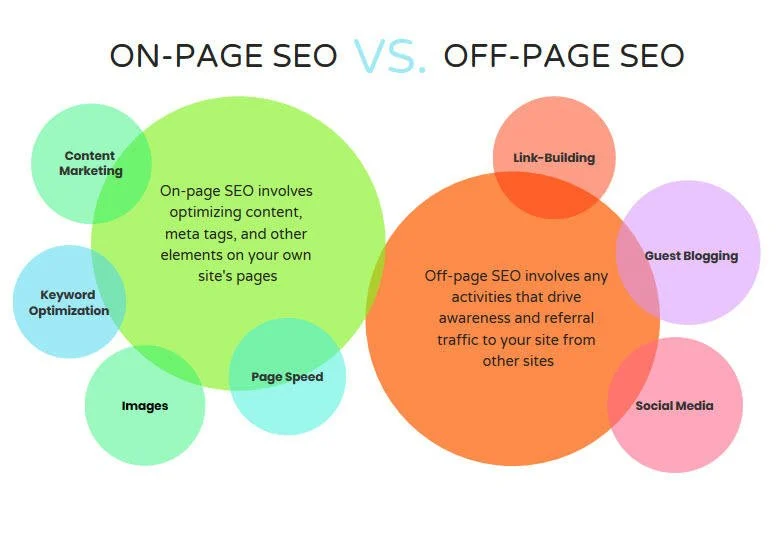
Source – wordstream
On Page SEO is for On-Page SEO is all about optimizing the parts of your site that you can control. This is how visitors perceive your website.
Off-page SEO, on the other hand, is all about building up your domain’s authority by creating content and building up your backlinks. This helps in creating authority and make a brand.
Balancing the two will help make your website optimized so that your visitors and search engines can understand it well – and that’s how you can improve your rank on google and get yourself on first page of Search Engine (Google).
Pingback: Search engine Optimisation (SEO)